reabc/Security Culture A Handbook for Activists/Security Culture A Handbook for Activists.pdf
Web PDF • Imposed PDF• Raw TXT (OCR)











Security Culture:
a handbook for activists
‘This handbook is the third edition of what we has been an evolving and
growing document dealing with securit issues and canadian activism,
We would like,to say a big thanks to the Collectve Opposifig Police
Brutaity in Mortreal for ediing some of e text of the original pamphiet
and adding 50 many great examples to the Informants and Infitrators
section. We have repicated many of thei changes in tis edtion. Thanks
also goes out to Eric Drooker whose artwork we used throughout this
pamphiet.
For more information or to make contribuions o this document - please.
email securitysite @tao.ca
‘Third edition - prepared November 2001,
Introduction
Resistance has been on the rise for the past f
years, with activists adopling more and more effective
tactics for fighting back. Our increased activity and
effectiveness has meant that the RCMP, F8l, and
local police have continued to escalate their activities
against us. As well, the events of September 11th and
ensuing state hysteria are no small footnote to the
way that our radical and revolutionary movements
have and will be targeted by repressive state forces.
If we want our direct action movement to continue, it
is imperative we start tightening our security and
taking ourselves more seriously. Now is the time to
adopt a security culture. Good security is certainly the
strongest defense we have.
This is a handbook for the Canadian activist who is
interested in creating and maintaining security
awareness and culiure in the radical movements. We
are always looking for contributions - so please feel
free to email securitysite @tao.ca with any images or
textyou think belong in a handbock such as this.
Thisis the third edition of this zine that we have put
outin order to add and improve on the original text
(thanks for the work of the Collective Opposing Police
Brutality in Monireal for their help). There will be
future editions of this har p putiin
forward suggestions (0 us.
We hope that you will put the material contained
ithin to good use. Now more than ever is the time to
Whatitis, why we need it
and how to implement it.
ACTIVISM AND STATE
REPRESSION
This pamphiet has essential
information for anyone asso-
« clated with groups advocating
or using economic disruption
or sabotage, theft, arson, self-
defence from police or more
militart tactics. The advice
that followsalso applies to
anyone associated with
groups practising civil dis-
obedience, especially since
people often workin several
groups at the same time and
gossip travels freely between
them.
Even if you've never
expressed your politics by
doing property damage,
pitching cobblestones, or
getting arrested for civil
disobedience; even if you
think you have nothing to
hide, these guidelines are
prosented here o enhance
your personal safety as well
as the overall effectivenass of
our movements.
The simple reality is that
governments in industrialized
countries target groups that
. advocate economic sabotage
and groups that don't, move-
ments that are mifitant and
movements that ara markedly
pacifist. The government's
security machinery serves the
elitst political and aconomic
objectives of capitalism. There
are over 250 political prison-
ersin Canada and the US that
can testify to this from firt
hand experience. By adopting
a security culture, we can limit
or neutralize counter-intell-
igence operations meant to
disrpt our political organ-
izing, be it mainstream or
underground.
Peasantrebels; communards;
liberatiorists; aboitionists;
labour organizers; revolut-
fonaries; from large uprisings
challenging the entre poltical
stiucture, to isolated erwiron-
mental and social struggles,
pecple have constantly worked
o croate a beter worid. The
response of govemment has
always been ropression to
preserve the status quo...
Historically, govemment
surveillance and harassment
has increased relative © he
ascendancy of direct action
movements. Minimizing the
destructiveness of political
repression requires that we
implement and promote a
security culture within our
movements.
SO WHAT IS A SECURITY
CULTURE?
I's a culture where the people
know their rights and, more
importantly, assert them. Those
who belong to a securtty culture
also know what behaviour
compromises security and they
are quick to educate those
people who, out of ignorance,
forgetfuness, or personal
weakness, partake in insecure
‘behaviour. This security con-
sciousness becomes a culture
when the group as a whole
makes securty violatons
socially unacceptable in the
group.
Securty culture is about more
than just targetting specific
behaviours in individuals such
as bragging, gossipping or ling.
Itis also about checking
movement behaviours and
pracices as a whol o ensure
that our own oppressive
practices don't feed into
intelligence operations being
carried out against our
communty.
For example, racism or sexism
in the movement can help to
spread dvision, make some
people more open 1o infitrators
{those who feel marginalized by
group practices), and create
openings that can be used by
state operatives. Qbviously, our
movements have a lot of work to
dobefore we address the bigger
questions - what's important
here s to recognize how
oppressive behaviours play into
bad secuity culture overall
(IN)SECURE PRACTICES
Activists like to talk, we
generally can spend hours and
hours discussing theory, taccs,
and stratsgy. Mostly this is
usefulin buiding our analysis
and our work, but in oter cases
this can be dangerous. .
WHAT NOT TO SAY
To begin with, there are certain
things that are inappropriate to
discuss. These things include:
> your involvement or someone
else’sinvolvement with an
undergound group
> someone else's desire to get
involved with such a group
> asking others f they are a
member of an underground
group
> your participation or someone
else’s participating in any action
that was illegal
> someane else's advocacy for
such actions,
> your plans or sameone ise’s
plans for a future action
Essentially, itis a bad idea to
speak about an individual's -
involvement (past, present or
future) with ilegal actvities.
‘These are unacceptable topics
of dscussion regardless of
whether it is rumor, speculation
or personal knowledge.
Please note: this s notto say
that it is incorrect to speak about
direct action in general tems. It
s perfectly legal, secure and
desirable that people speak out
* in support of mokeywrenching
andall foms of resistance. The
danger i in linking indvidual
acivists to specifc actons or
groups.
‘THREE EXCEPTIONS
There are only three times thatit
is acceptable b speak about
specific actions and activist
involvement.
‘The st situaton would be if
Youwere planning an action
with other members of your
small group (your elf or
“affinity group"). However, hese
discussions should never take
place over the Intemet (email)
phone line, through the mail, or
in an achvist's home or car, as
these places and forms of
‘communicaton are frequenty
‘monitored. The only people who
should7dear this discussion
would include those who are
actively participating iXathe
action. Ayone who is not
- involved does not need to know
and, therefore, should not know.
The second exception occures
- after an activist has been
trustworthy can often be tricked
arrested and brought to tial. If
/e s found guity, this activist
can freely speak of the actions
for which s/he was convicted.
However, /e must never give
infommation that would help the
autorities determine who else
participated in ilegal activities.
The third exception is for anony-
mous letters and interviews with
the media. This must be done
very caretully and without
compromising securty. Advice
on secure communication
techniques can be found at
hito://security.taoca.
These are the only situations
whenitis appropriate to speak
aboutyou own or someone
else’s involvemert or intent to
commit legal direct acton.
‘SECURITY MEASURES
Veteran activists only allow a
select few to know about their
involvement with direct action
groups. Those few consist of the,
cell members who they do the
actions with AND NO ONE
ELSEI
‘The reason for these security
precautions is obvious: if people
don't know anything, they can't
talk about . When actvists who
do not share the same serious
consequences know who did an
illegal direct acton, they are far
more fikely to talk after being
harassed and infmidated by the
authorities, because they are
not the anes who will go to jail.
Even those people who are
by the auhorities nto revealing do serious damage to our
damaging and incriminating securty.
information. I is safest for all
cell members to keep their ‘The following are examples of
involvement in the group ‘security-violating behaviours:
‘amongst themselves. The fewer
pecple who know, the less Lying: Toimpress others, liars
evidence there is in the long claim to have done ilegal
un. ‘actions. Such lies not only
compromise the person's
security -~ s cops will not take
SECURITY VIOLATING whatis said as a e~ butalso
BEHAVIOURS hinders solidarity and trust.
In an attempt o impress others, Gossiping: Some people think
activists may behave in ways they can win friends because
that compromise security. Some they are privy to special
people do this frequently - they information. These gossips will
ae habitually gossiping and tell others about who did what
bragging. Some activists say action or, f hey don't know who
inappropriate things only when did it, guess at who they think
they consume alcohol. Many did what actions or just spread
activists make occasional rumors about who did .
breeches of securty because
there was a momentary This sort of tak is very dama-
temptation to say something or ging. People need to remember
hintat something that shouldn't that rumors are all that are
have been said or implied. In needed 1o instgate an
most every situation, the desie investigation or even lay
10 be acceptedis the root charges.
cause.
Bragging: Some people who
‘Those people who tend to be partake in ilegal direct action
the greatest secuity risks are might be tempted 1o brag about
those activists who have low it 1o their friends. This not only.
self-esteem and strongly desite jeopardizes the bragger's
the approval of their peers. securly, butalso hat of the
Certainly itis natural to seek other people invalved with the
frisndship and recognition for action (as ey may be
our efforts, but itis imperative suspected by association). As
that we keep these desires in- well the people who s/ fod
check so we do not jecpardize can be charged as accessories
the safety of other activists or after the fact. An actvist who
ourselves. People who place brags also sets a bad example.
their desire for friendship over Indirect-Bragging: Indrect-
the importance of the cause can braggers are people who make *
a big production on how they
wantto remain anonymous,
avoid profests, and stay
“underground.” They might not
‘come out and say that they do
ilegal direct action, but they
make sure everyone within ear-
shotknows they are up to
something.
They are no better than
braggers, butthey try to be
more sophisticated about it by
pretending 1 maintain security.
However, i they were serious
about secuty, they would just
‘make up a good excuse as to
why they are not as actve, or
why they can'tmake itto the
protest . Concealing sensitive
information from even trusied
comrades is far betier than
Jeopardising underground work.
EDUCATE TO LIBERATE
The unfortunate truth is tere
are some securty-ignorant
pecple in the movement and
others who have possibly been
raised in a "scene* that thrives
on bragging and gossiping. It
doesn't mean these people are
bad, butit does mean they need
to inform themselves and leam
about personal and group
securty. Even seasoned
activists make mistakes when
thers is a general lack of
security consciousness in our
groups.
And that's where those of you
Who are reading this can help.
- We must ALWAYS act to inform
persons whose behaviour
breaches securty. If someone
you know is bragging about
doing an action or spreading
securty-compromising gossip, it
is your responsibiity to explain
10 her or him why that sort of
tak violates security and s
inappropriate.
You should stive to share this
knowledge in a manner hat
encourages he person' s
understanding and changes her/
his behaviour. It should be done
without damaging the person's
pride. Show your sincere
interestin helping him/her to
became a more effective
activist. Keep your humilty and
‘avoid presenting an atitude of
superiority. An insensitive.
approach can raise an
individual's defences and
prevent hem from listening to
and using the advice offered.
The goal of addressing these
issues with others is to reduce
insecure behaviour, rather than
showing how much more.
security-conscious you are.
Share your concems and
knowledge n private, so that the
person doesnat feel as f they.
are being publicly humiliated.
Addressing the person as soon
as possible aftr the securlty
violation increases effective-
ness.
If each of us remains res-
ponsible for discussing security
information with peopie who slip
up, we can dramatically improve
security in our groups and.
activities. When people
recogrise hatling, gossiping,
bragging, and inappropriate
debriefing damages both
themselves and others; hese
behaviours wil soon end.
By developing a culture where
breaches of security are pointed
outand dscouraged, all sincere
activists wil quickly understand
'DEALING WITH CHRONIC
SECURITY PROBLEMS
So whatdo we do with activists
who repeatedy violate security
precautions even after being
informed several times?
Unfortunately for them, the best
thing to dois to cut them loose.
Discuss the issue openly and
ask them to leave your meet-
ings, basecamps and organ-
izations. With law enforcement
budgets on the increase, new
anttermorist laws that call for
stifer sentences for poitical
actions, and with courts
handing down long sentences
for poliical “crimes”, the stakes
are too high to allow chronic
security offenders to work
among us.
By creating a security culture,
we have an effective defence
against informers and agents
who ty to infitrate groups.
Imagine an informer who, every
time they ask another activist
about their activities, receives
information about securty. It
would frustrate the informer's
work. When other activists
discovered tat shelhe
continued 1 violate security
precautions aer being
repeatedly informed, there
would be grounds for isdlating
the person from our groups. And
that wouid be ane less informer
for us to deal with!
a brief primer on the
canadian state security apparatus
Recent incidents of repression
against activists in British
Golumbia iluminate the need for
grassrocts people to understand
and practice movement security.
Police monitoring, infitration and
agent provocateurs are routinely
used by the state to collect
information about our groups, or
specific.individuals in them, and
to subvert our activities.
For example, during the APEC
hearngs, t was revealed that
over severty groups and
individuals were monitored
before and during the APEC
meatings n 1997. A paid
industry informant/disruptor was
identified ata wildemess action
camp in 1999. Provocateurs
also targeted some Vancouver
activist, bying o convince them
to dsdlose information and as
‘well, to break the law.
The Canadian security
apparatus identifies a number of
our groups and activities as a
threat to "national security”.
People and orgarizations are
. widely targeted; even avowed
pacifists have been included in
surveillance and repressive
. measures. According to the
Ganadian Securty and
Inteligence Service's (CSIS)
annual reports, actvities
targeted in e late 19905
included: native resistanc,
environmental & animal rights
movements, ant-poverty, anti-
globalization, anti police
brutalty, antracist, anarchist
‘and communist groups.
With the rise in miltant First
Nations' struggles; covert direct !
‘action against corporations; the
renewed miltancy and strength
of popular struggles; and the
mass-media's increasing focus
on anarchists and anti-
globalization protests, there is.
also a growing level of police:
survellance and repression.
‘The need for securty in our
movements is obvious -
however, it is incredibly
important that we don' fall into
the trap of using our awarenass |,
of securiy issues to shut other +
pecple out of our growing K
movements. 3
One of the key aims of the FBI's <
Courternteligence Program
("COINTELPRO") operations
against the Black Panthers and
American Indian Movement
(AIM) was to spread distrust and
paranoia so that these activists operations level, the new
would be reluctant to integrate ‘agency was granted more lee-
new people into their struggles. way in terms of public account:
abiity than the Mounties had
A securty cuture can existin a ever had.
large movement; indoed, tis
one indication of a movement's CSIS cares outa wide range of
strength. Arming ourselves with suneilance actvites. Since
knowledge about how the they are nota law-enforcement
system works and works against agency and since their evidence
activists is essental in buiding is notused in court, nothing
security culture. The aim of this stops them from contravening
section s to give a bref un the few regulations that do
down of the working of domestic exist regarding privacy rights.
inteligence in Canada. In this For example, CSIS is not -
way, we can better understand required to inform people, as is
how 0 avoid ts traps. RCMP, ninety days after a
wiretap (or bugging)is over.
AN OVERVIEW OF
DOMESTIC INTELLIGENCE Agents working for CSIS are
ORGANIZATIONS allowed, with “authorizatior, to
enter people’s homes © plant
The Canadian Security and bugs, wiretap phones, open mail
Inteligence Setvice (GSIS) is and look into health,
probably fhe best known of the employment and govemment
“securty” agencies hat deal records without ever having to
with actvist “threats". s tell a targeted indvidual what
predecessor was the Secuity they are doing. The information
Service diision of the Royal that they gather is used to build
Canadian Mounted Police, profiles and dossiers (fles) on
(RCMP-SS). In 1984, following
the MacDonald Commission on
the ilegal activites of the
individuals, orgarizations,
networks, et This information
is also passed on o other wings
RCMP, the civilian spy agency of the federal security system
CSIS tock over RCMP spy who are responsible for “law-
work. That said, he RCMP did enforcement’, and wil then
notabandon is inteligence obiain whatever warants are
gathering, it's just that CSIS necessary forlegal surveillance
specifically gathers poliical (to be brought into courtas
inteligence. evidence).
The spit from the RCMP The National Security Invest-
allowed the new spy agency to igation Service (NSIS) is he
dolegally what the Mounties primary law-enforcement wing in -
had been daing ilegaly. At the Canada. The NSIS i a section
of the Royal Canadian Mounted
Police (RCMP). Most major
cities across the country have
an NSIS offce including Van-
‘couver, Edmonton, Montreal,
Ottawa, and Toronto. The NSIS
maintains a computer database
on activists, immigrants and so
called "terrorists* which is
housed in Ottawa.
Itis believed that the Vancouver
NSIS employs between 12 and
18 members. Within NSIS there
. are several sub-groups called
Team 1, Team 2, Team 3 - stc.
that have different invesfgatve
targets.
‘They employ informants,
infitrators, personal physical
sunveilance, electroric
surveifance including phone
‘and room *bugs* and other
‘means of investigation and
research.
The RCMPINSIS also have
other resources at their disposal
during counter-nsurgency
operations. *Special 0" is a
team of sueilance specialists
that may be called upon.
“Special I is a penetration team
whose specialty is to break into
homes, veicles and other
properties for investigatve
pumoses. They are the team,
‘which among other things,
installslistening devices,
photographs buiding interiors,
ete.
In along-running case based in
Vancouver, all of these methods
of suveilance were used
against several Vancouver
activists. Duing the Vancouver
investigation, house and vehicle
bugs were located by some
targeted indviduals. The bugs
had large battery packs
attached to faciitate less.
frequent battery changes. The
NSIS also visited several
activists across Canada in an
attempt 1o question them
regardng the indviduals under
investigation.
THE GOLDEN RULE OF
SILENCE
It needsto be stressed
throughout our movements hat
10 0ne is under any legal
obligation b provide to the:
police anymors information than
one's own name, address and
birth dats, and tis only if one is
under amest, That is itl Saying
anything more jeopardizes
security. Even answering soem-
ingly insignificant questons can
assist ihe police in developing
personalty profies on a range of
activists. Itmay not be.
“evidence" but it s used to give
police eads* on other suspects
and constuct intent during legal
‘procesdngs. The only principled
response to police questioning
when under arest is to say
nothing more than your name,
birth date and adcress: If
questioned urther you can
simply say *l have noting to say
(except in the presence of my
lawyer"
The Communications Security
Estabishment (CSE) is an
agency of e National Deferce
/ War department, which has
been long clouded in secrecy.
They collect and process
telephone, fax and computer
communications of foreign
states, coporations and
individuals. The federal
govemment uses the
intelligence gleaned from the
data to support troops abroad,
catch "tarorists* and *futher
Canadas economic goals”
(what that means is up to them).
Although the CSE is not
technically allowed o collect the
communicatons of Canadian
citzens, it is known to be a
partner in the Echelon project -
a malinational monitoring
operation which sees CSE and
counterpart agencies in the
United States, Bitain, Austalia
and New Zealand share
intercepted communications of
interest with one another,
effectively creating a global
surveillance web.
The Terrorist Extremist Section
(TES-Uni)is British Columbia’s
antterrorst unit. A joint
VancouvedVictoria Police
DepartmenVRCMP unit called
the Organized Crime Agency
(tormerty the Coordinated Law
Enfocement Unit - CLEU),itis
believed that the this unit
employs o or three members
only.
Most acivists wil be initimately
familiar with their local police
forces. Be aware that cops do
notonly show up in biue
uniforms - but outinely practice
crowd infitraton and camy ot
surveillance and investigative
activities either alone o jointly
with the RCMP depending on
the type of case. Watch for them
‘on demonstrations - as they lie:
to come along and take photo-
graphs and video for the record -
and they often appear in crowds
as "fellow demonstrators”.
‘THE COUNTER-
INSURGENCY MODEL
Most Westem nation-states
follow a model of counter-
insurgency developed by a
British inteligence expert named
Kitson who wrote, Low htensity
Operations, after much field
work in the calonies. He broke
down movement development
into three stages:
‘The Preparatory Phase: is
‘when the movementis smal,
tends 1o focus on educaton,
publishing and groundwork.
‘The Non-Violent Phase: is
‘when the movement takes on
more of a mass character. Large
demonstrations are the norm.
Inthe Insurgency Phase: the
movement has taken on a
popular character. Perhaps a
more assertive, guerila
component has emerged.
Kitson advises that the primary work of the intaligence agency shoud
occur during the preparatory phase. Atthis time the movements are
most ulnerable. They have not experienced a high degree of
repression. They consider talk of security as mere paranoia. As they
are not breaking laws they believe that it is safe to organize completely
openly. The inteligence agency is therefore able to exploit these
conditions and develop detailed dossiers on a wide range of pecple.
The information will be extremely valuable to them later on.
Important historical revalutionary activiies and groups began as small,
serious-minded projects that grew in spite of surveillance and
repression. Its therefore important to practice security at all points in
the movement's dsvelopment. State agents gather more than just
*hard evidence;" they are interested in knowing about radicals’ beliefs
as well
Police try to control with fear; don't be infimidated. Remember -If an
agent comes knockin', do no talkin'.
everything you ever wanted to know
about informers and
infiltrators
Infltrators seek information on most radical groups. The retum of
mass mobilizations and radical actions in ant-globaiization, ant-
poverty, anti-racism and anti-police brutality demonstratons, as well
as declaratons o continue struggling in the streets and underground
“has drawn attenon from the state's secret police. More infirators wil
be sentinto our ranks 1o ry 1o bribe, entice or manipuiate individuals.
The extent 1o which
they are able to infitrate our groups depends on our seriousness and
responsibilty in leaming abowt, promoting, and working within a
security culture.
Radical movements can leam to better identify covert enemies in our
projects. Once identiied, appropriate action is needed to undo,
contain, or remove the danger.
‘This section is intended to am you with information on how o spot
and deal with informers, infitrators, and provocateurs in our ranks.
WHO IS AN INFORMER?
There are actually two kinds of
informers. The deliberate
informer is an undercover agent
onthe payrol of govemment or
industry. The second type is the
activisttumed-informer. Both
Kinds 10 inftrate our ranks
and are equally dangerous 1o
our movemen.
Lets discuss the deliberate
informers first. They are often
diffcuit to identity. Informers can
be of any age and any profie,
butthey do have a few discem-
ible methods or operation, or
“modus operand. These are:
““The *hang around" type: they
are parsons who regulary show
at meetings and actions but
generally dont get involved.
They collect documents, isten
to conversations and nole who's
who. This abservation role is
relatively inactive.
“*The *sleeper” type: is simiar
to the "hang around" modus
operand, except that their
absorption of information is
used to actvate their role ata
later date
**The *novice" type: presents a
‘somewhat more active role, but
confines hemselves to less
prominent work. They don'ttake
Initiatives, but the work they do
is valued. This helps them build
trust and credibility.
**The "super activist” type: they
come outof nowhere and all of
a sudden, they are everywher.
Whether it's a meefing, profest,
or an acon, this person will be
fight in the thick of t. Keep in
mind however that this can
also be the mark of a new
activist, whose erthusiasm and
commitment s so strong that
shehe wants to fight the power
every minute of the day.
It shouid be said that with
several of fhese modus oper-
and, the bshaviour is hard to
distinguish fom a sincere new
person's involvement. How do
we tel them apart? Well, a
planted infitrator will ask a lot of
questions about the direct action
groups, individuais and legal
activities. Shehe may suggest
tamgets and volunteer to do
feconnaissance as wel as take
partin the action. Infitrators
also by to buid profiles on
individuals, thei belefs, habits,
friends, and weaknesses. At the
same time, infitrators wil shield
their true selves from other
activists
Anyone who asks a ot of
questions about drect actons
isn't necessarlly an infitator,
butthey ARE somecne you
should be careful with. Atthe
very least, they need 1o be
informed about secuty issues.
New activists shoud understand
that direct action tactics can be
tisky (though some risks are
worth takingl) and that asking a
ot of quesions endangers
people. If the person persists in
asking questions, there is a
problem and appropriate meas-
ures must be taken. Activists
who can'tunderstand the need
for security should be shunned
and kept away from the move-
ment.
‘Some types of infitrators stay in
the background and offer
material suppor, other infom-
ants may have nothing to do
with the group or action, but
initialy heard certain plans and
tipped of the police. Among the
more acive types of infitrators
can be a gregarious person that
qQuickly wins group trust. Some -
infitrators wil atemptto gain
key forms of control, such as of
communicatons/ secretarial, or
finances. Other informants can
use cham and sex to get
intimate with activists, to better
spy or potentally destabiize
group dynamics.
Active infitrators can aiso be
provocateurs specializing in
disruptive tactios such as
sowing disorder and demoraliz-
ing meetings or demos, height-
‘ening confiicts whether they are.
interpersonal or about action or
theory, or pushing things further
with bravado and violent pro
posas. Infirators often need to
build credibiity; they may do this
by claiming to have participated
in past actions.
Also, inftrators wil try to exploit
activist sensibilties regarding
oppression and diversity. Intel
gence organizations will send in
someone who will pose as a
person experiencing the com-
mon oppression of e particular
‘activist group. For example, in
the 1960's, the Weather Under-
ground ("Weathermen - a white:
an-mperialist amed struggle
in the US) was infirated by an
*ordinary Joe" informant with a
working class image. Black war
veterans infitrated the Black
Panther Party.
A fresh example of poiice.
infitration and manipuation
tactis is that of Germinal, a
group targeted for anest two
days prior 1o the April 2001 anti-
FTAA demonstrations in Quebec
Ciy. Five months prior, the
police set up a faise ransport
company and specifically
postered oppodunties for
employment in the vicinity of a
Germinal member seeking
employment.
The rap worked. Tipped off by
an initial infomant, two under-
cover cops worked for four
months in the group. This
operation resuited in the media-
hyped “dismantiement" of
the growp on the eve of the
summit. Seven Gemminal mem-
bers were amested, 5 of whom
spent 41 days in preventive
custody, only to be released
under draconian bail conditions.
The police’s covert action was in
part about dismanting he
group, butit was also about
creating a media/propaganda
campaign o jusfy the police-
state secuiy for the summit.
BACKGROUND CHECKS -
AN ESSENTIAL TOOL
What are some ways of looking
into the possibilty that someone
s an informer? Firstly, unless
you have concrete reasons or
‘evidence that someone is an
infitrator, spreading rumours will
damage the movement. Ru-
mours that you do hear of
should be questioned and
traced back.
A person's background can be
looked into, especially actvism
they claimed to have parti
patedin, in other places. Do
your contacts in those places
know of the persan, heir in-
Volvement? Did problems ever
come up? One important
advantage of having links with
far away places is that it makes
it more dificul or informers to
fabricate claims about heir
activiies.
Whatare a person's means of
living? Who are her or his
friends? What sorts of conradic-
tions exist between their pro-
fessed ideals and how they live?
One of our strengths as activists.
is ourideas and values, our
countercuture, our atttudes
towards the dominant scciety.
Our sincerty in discussing these
things is also away of leaming
about each other.
When planning for new actions,
care must be taken conceming
Who s approached. As little as
possible should be said about
the actual action plen until a
persor's poltical phiosophy,
ideas about strategy, and levels
of risk they are wiling to engage
in have been discussed on an
abstact basis. Ifthere is a
strong basis for believing this
person might be interested in
the action, then the general idea
of an action can be un by
them. Only when they have
agreedto participate, do they
come to the group to discuss
action details.
During the trials of activists,
police often reveal the kinds of
information that they have
gathered conceming our groups.
and actvities. Note what revela-
tions come out of these tials.
What are the possible and likely
sources of the information?
‘Speak o persons that have.
been arrested and interrogated
to see whatthey may have said
to the poiice, or discussed in
their jail cell.
Placing infitrators n social
Justice and revolutionary move-
ments is an established prac-
tice. K was done 1 the Black
Panthers, AIM, the Front do
Libération du Québec (FLQ),
andthe peace/ ant-war/and
antnuciear movements on a
large scale. Small groups, such
as affinity groups, or working
groups of larger more open
organizations, need o be
especially careul with new
members. Direct action organiz-
ing s ideally done with
longstanding, trusted members
of the activist community.
This doesn't mean thatno one
else shouid ever be allowed ino
these groups. On the contrary, if
our movementis to continue to
grow, new people shoud be
welcome and recruited; we just
need 1o keep security in mind
and exercise caution at all
times.
The Unwitting Informer
Possibly an even greater threat
10 our movements than the
covert operative is the actvist-
tumed-informer, either unwit-
tingly o through coercion.
The unwitting informer i the
actvist who carit keep hisher
mouth shut. i someone brags
you about what theyve done,
make sure this person never
has any knowledge that can
incriminato you, because sooner
or later, he wrong person wil
hear oft. These activsts dorit
mean o do ham, but their
bragging can be very damaging.
Itis your responsibilty to Jail time at this pointin your life.
instruct hese people on the As long as capitalism and all of
importance of securty culture. its evis exist, there wil be
resistance. In other words, here
The other type of activist- will be plenty of great actions for
informer is the person who You'to participate in when your
cracks under pressure and ite circumstances are more
starts talking to save his or favourable.
her own skin. Many activists get
drawn into situatons they are f others are dependent on you
notabie to hande, and some for support, you aren't wiling to
are socaught up in the *excite- lose your job, or drop out of
ment" that ey either don't schodt or ruin your future career,
realize what he consequences DON'T DO THE ACTION. If you
can be, or they just don't think are addcted to an ilicit drug
theyl ever have to face them. andor have a lengthy
criminal record, the cops will
Keep inmind that the catego- use this to pressure you for
ties of “planted informer” and information. you don't feel
“actvisttumedinfomner” can, capable of detoxing under
and have been blumred. In 1970, interrogation and brutalty, or
during the height of the FLQ'S doing a hel of a lot more time
activities, Carole do Vault- a than your comrades, DON'T DO
young Parti Quebecos (PQ) THE ACTION.
activist was drawn to the FLQ,
butthen became apaid police Make cetain that you talk with
agent. Hor "activism was with others in your affinity group
the PQ; she disagreed withthe about situations that make you
heavier FLQ actions since it uncertain whether you shoud
threatened the “legitimate" work. be involved in particular actions,
of the PQ. Her involvement especially those that are ata
with the FLQ was as a planted high risk of being criminalized.
police informer.
Remember - there is no excuse
KNOW YOUR OWN LIMITS for tuming in comrades b the
police - and those activists hat
We have to know the possible do efiectively excommunicate
consequences of every action themselves from our move-
we take and be prepared to ments. We must offer no legal
deal with them. There is no orjail support to those activists
‘shame in not being able to do Who um in others for their
an action because of fesponsi- impact on our movementis far-
bilties or cicumstances that reaching and can have devas-
make it mpassible for youtodo tating effects.
COVERT ACTION OTHER
THAN INFILTRATION
Covert (or *Special") Action
from police and secret service is
also done outside of the group,
With or withoutinfitration. These
florts include: intimidaion and
harassment, blackmafl and
manipuiation, propaganda,
informing employers and
securty checks, as well as
physical sabotage ke theftand
arson.
Intimidaton and harassment
can include visits from secret
service agents, caling you or
Your pariner by their first name.
on the street, thefts where
obvious clues are left. Police
will try to blackmail people if
they wantto recrult or neutralize
them,
Police uses propaganda in an
attempt © poison the atmos-
phere and manipulate media
and public opinion. In Decem-
ber 1971, when the FLQ was
near its end and heavily infi-
trated, the RCMP issued a false
FLQ communiqué in the name
of the "Minerve" cell. The
‘communiqué adopted a hard-
line position, dencuncing the
abandonment of terrorist action
by a well-known activist, Plerre
Valiéres, and uging the con-
tinuation of armed stugge.
In Genoa, ltaly, police played an
active covert role in trying to
discredit biack boc anarchists
during the July 2001 meeting of
the G8. Several reports reveal
that ltaian police masked as
black bloc members atiacked
demonstrators and small shops.
With a lack of public information,
the police help manipulate
public discourse along the fines
of "how dolegitimate demon-
strators isolate activist thugs?*
Slanderous propaganda can
take the fom of anonymous
letters, o rumours aimed at the
activist mileu. There are also .
examples where poiice will
make uncoroborated, casual
accusations to jounalists that,
1o use two examples, a person
is a drug dealer, or that at a
demonstration, a person aimed
a handgun at an officer. It is
often for slanderous reasons
that police charge activists with
“weapons possession’ for
having a penkife, or charges of
violence ke "assault”
The growth of the anti globaliza-
tion movement has been ac-
companied by renewed anar-
chist-scare propaganda on he
part of authoriies. Poiticians
and police attempt to massage
public opiion, preparing
people for a crack down, in
order b legitimate the use of
heavier methods of social
control, exclusion and
reprossion.
Manipuative disinformation
spread through the media needs
to be denounced as lies. There
N
are activist-friendly lawyers who can help us demand retractions and
comections. Speak to the joumalists involved, call them on their
sloppy, dishonest work, expose their hypocrisy, and complain to the
joumnalists' ethics body. We can not rely on capitalist, private-media
for any kind of faimess.
Itis valuable for us 1o leam more about the covert actions of the
police. There exists a long and documented history. Factual informa-
tion about police covert activities also comes out as evidence pre-
sented in court. An important, too often neglected part of our strength
s our knowledge of, and our protecton from, police action against
us
MOVING AGAINST INFORMERS:
CONSIDERATIONS AND ALTERNATIVES
(Taken from PROTECTING OURSELVES FROM STATE REPRESSION:
AMANUAL FOR REVOLUTIONARY ACTIVISTS. Published in 1984 by
the Ant-Repression Resource Team - Jackson, Mississippi)
Assuming that e secuity
pecple within e group have
suspicions about a group
‘member being an informer/
provocateur, it s useful for
securityleadership 1o rasolve
certain questions both before
and atter the investigation:
() How badly do you want o
know whether the person is in
agentor not? Clearly, f the.
person under suspicion is
relatively important to the
group's funcfoning, hen leader-
ship mustknow one way or the
other. The more important the
person under suspicion is o the
group, the more intensive the
investigation. We may suggest
methods of investigation which
are unorthodox and from.a
certain point of view morally
indefensible. Butthe question is
always how badly e group
needs o know. No group nead
use all or any of the methods we.
describe. But under the cond-
tion that the correct information
is a life-and-death mater for the
group, certain drastic measures
may be justified.
(b) What will be done i the
information s inconclusive?
Often there s not enough
‘evidence to confim that some-
oneis apolice agent, but there
1S enough evidence 1o confim
certain suspicions. A great deal
will depend upon whatis at
stake with the person under
suspicion. In general, the
choioes come down to
1) labeling the person a secuity
tisk and acting accordingly;
2) doing nothing outwardly but
continuing the investigation;
3) isolating he person fom
sensitive work but keeping him
or her in the group;
4)moving to a higher stage of
investigation.
(c) What will be done If the.
person does tum out to be an
agent? While common sense
dictates that the person be
exposed and severed from the
group, other actions might be
iniiated. ¥ the presence of the
agentis a rel threat to he
group, then the agent shouid be
neutralized in an effective
manner. Usually wide exposure
E
of the agent will accomplish an
effective neutralization. But f the
agentis no great threat to the
group's funconing, the agent
staying inside the group may be
uselul for other purposes.
The group might decide that
they prefer to keep he agent,
rather than risk not knowing who
would replace a known quantiy.
Itthe agentis not n a sensitive
positon, can be monitored and
isolated from important work, the
group may wantto keep such an
agentata low organizational
level. Or the agent might be
given tasks that seem to be
sensitive but are in reality not
crucial to the group. Under the
cover of doing *sensitive® work,
false and semi-alse information
aboutthe group can be relayed
to he inteligence agencies that
the agent belongs to. Or per-
haps certain information thatis
in fact true about the group can
b wilfull discredited by crea-
tion of pseudo-events andbr
faise information. Remember
that when he inteligence
agencies have a great deal of
contadictory information, it
decreases their abilty to act
decisively against he group.
() What are the responsibities
10 ather groups of e group's
knowledge of an informer? Ifthe:
group makes a decision to sever
connection with the agent tis
certainly the group's responsibii
ity to quietly contactleadership
in other groups to wam them
aboutthe agent. Often public
exposure is done through the
group's newspaperinewsletier/
joumal; in this case, e news
article should be sent to a wide
variety of groups. The more
pressing problem is the instance
Where here ars only suspicions
butnot decisive evidence.
Experience has shown that
suspicions are taken seriously
only when then is a politcal
bond that exists between
persons with long movement
experience. People who have
been in the movement a long
time, and who are known to
‘each other and trusted as
dedcated movement people,
can convey agent suspicions
that wil geta favorable hearing
or be readiy believed. This 'old
hands bust network” is relatively
independent of political point of
view, veteran leaders of rival
radical organizations can freely
and easily exchange infomation
on matters of security.
L
1. YOU DON'T HAVE TO TALK TO THE POLICE OR
INVESTIGATORS. You em on
i v
3t tak about ilegal actior:
in holding as they may be plant
2. YOU DON'T HAVE TO LET CSIS OR THE POLICE
INTO YOUR HOME OR OFFICE UNLESS THEY
HAVE A SEARCH OR ARREST WARRANT. Demand
rant. It must spe: th
ized. It mu
3. IF THE POLICE DO PRESENT A WARRANT, YOU
DO NOTHAVE TO TELL THEM ANYTHING OTHER
THAN YOU NAWE, ADDRESS AND BIRTH DATE.
Carefull the offic
ou're not requi oom. You
should take writ y do, their
names, badg
from. Have friends
our place.
4. IF THE POLICE TRY TO QUESTION YOU OR TRY
TO ENTER YOUR HOME WITHOUT A WARRANT,
JUST SAY NO. Th y skill
rmation D s attempting 1o ol
[}
ery risky. You can never tell h
miess bit of infor
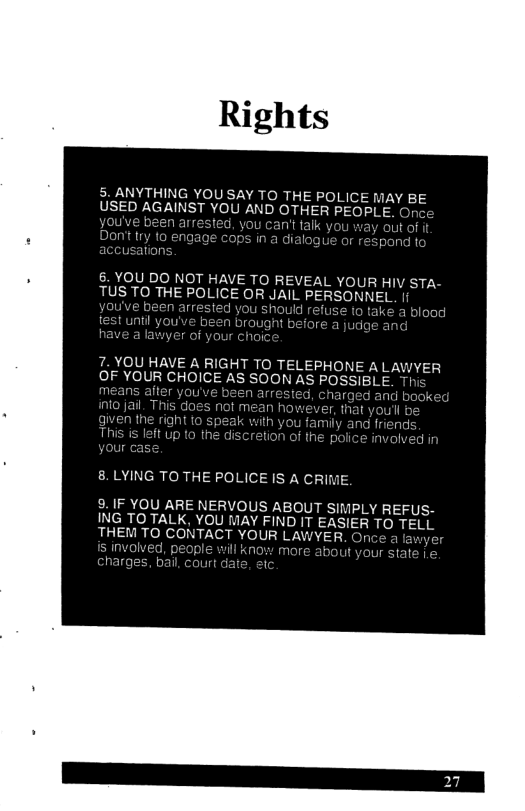
THE POLICE MAY BE
USED AGAINST YOU AND OTHER PEOPLE.
ed, y 't alk you way out of it
6. YOU DO NOT HAVE TO REVEAL YOUR HIV STA-
TUS TO THE POLICE OR JAIL PERSONNEL .
7. YOU HAVE A RIGHT TO TELEPHONE A LAWYER
OF YOUR CHOICE AS SOON AS P
8.LYING TO THE POLICE IS A CRI
8. IF YOU ARE NERVOUS ABOUT SIMPLY REFUS-
ING TO TALK, YOU MAY FIND IT EASIER TO TELL
THEM TO CONTACT YOUR LAWYER. Once a Ia
& will know more a
e, e
@ S°Uh Chicago ABG
Zine Distro
@ P.O. Box 721
Homawood IL 60430